

From the Black Prince to Roald Dahl, the Chilterns have been home to a legion of famous people. The landscapes have inspired artists, writers, musicians and great political figures.
Now, their life stories have been told in Famous People of the Chilterns, a series of CWW walks led by Nettie Dearmun and Simon Kearey. As with all our walks, the leader pens a write-up for the weekly newsletter. But in a stroke of literary genius, Nettie has looked inside the mind of each famous person to imagine how they might have composed the walk report.
The first walk brought arguably the biggest challenge… to report on a stroll around Princes Risborough in the style of the bloodthirsty military commander after whom the town is named – one of the greatest knights of the Middle Ages, Edward of Woodstock, the Black Prince.
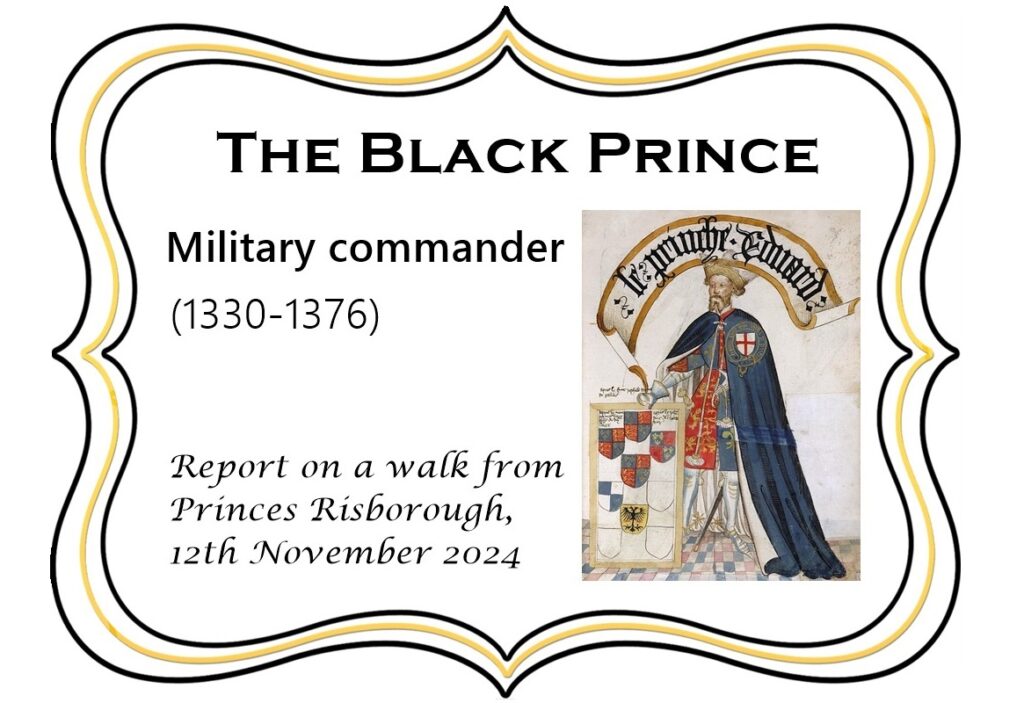
In ye fayre towne of Princes Risborough, walkinge became a celebration of lyfe, nature, and the timeless bonds of fellowship as twenty rambleres set out upon a crisp day.
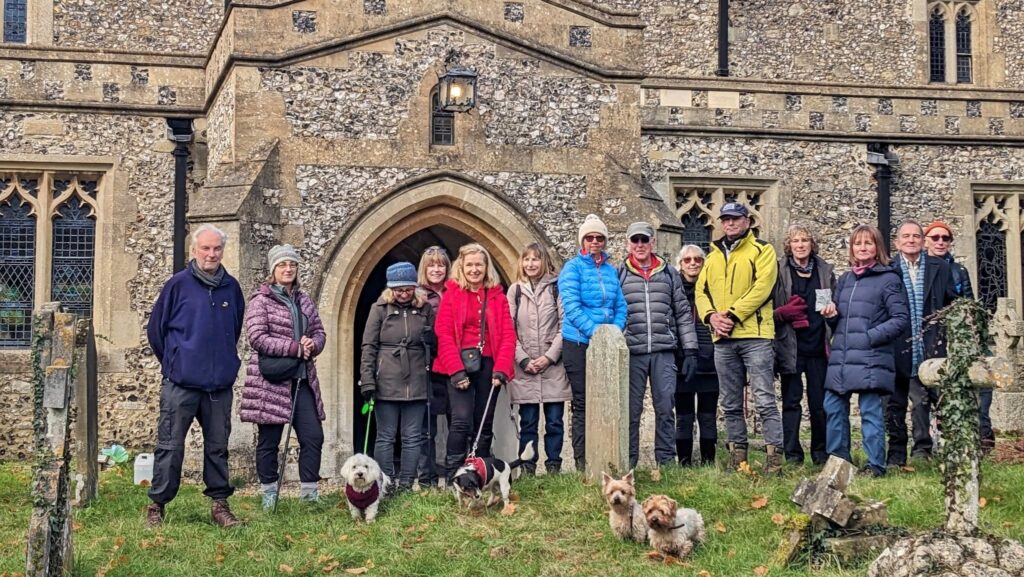
Ledde by Sir Simon, a wisened knyght, and Lady Nettie, they wandréd ‘neath verdant meadows and sylvan shades. The aire was filled wyth ye sweet harmony of nature’s symphony. They passed through hamlets and in fields their boots mudith did make. At sunset they returnéd and rested at the Cafe of Crew, sharing a simple feast and merry tales.
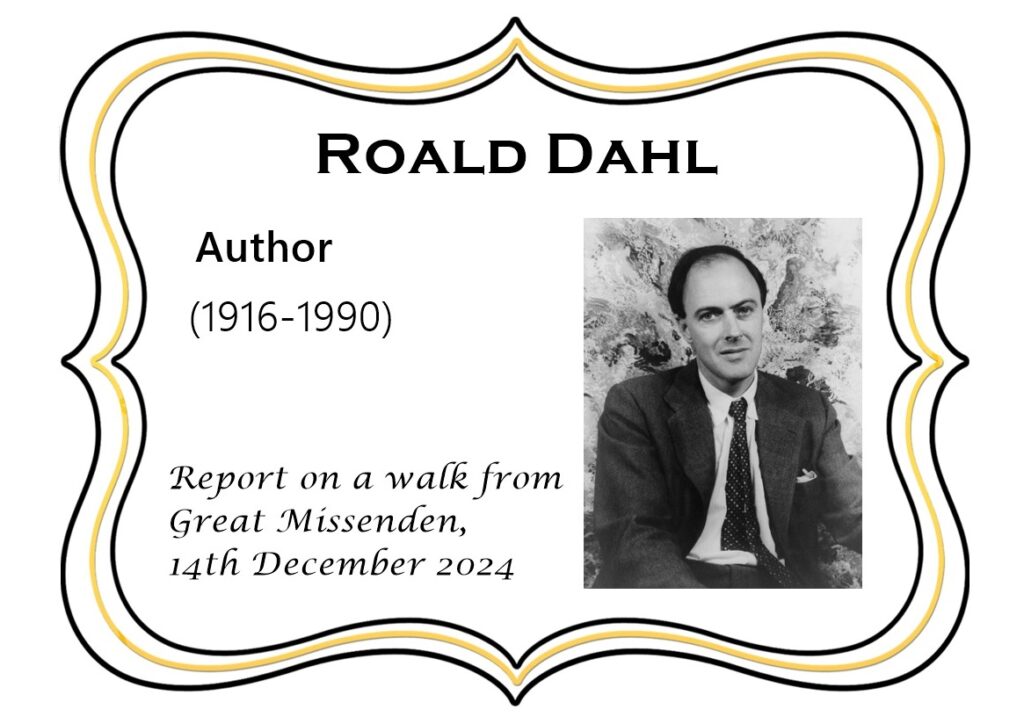
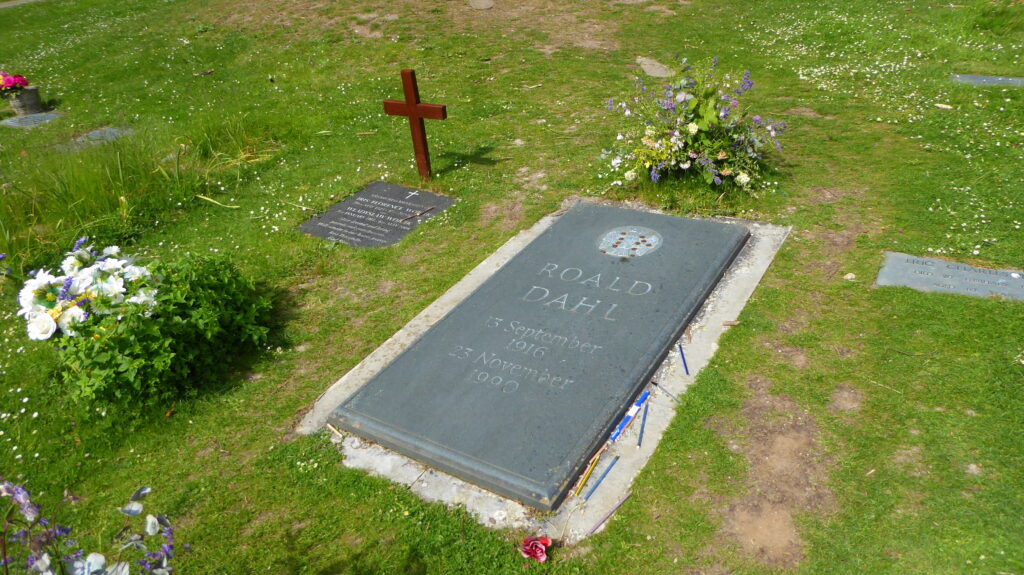
In a little village called Great Missenden, twelve ramblers, each with a peculiar hat, set off on an adventure led by Old Mr Kearey, a man with a nose as sharp as a pencil, and young Nettie, bearing gifts of Lidl stollen bites.
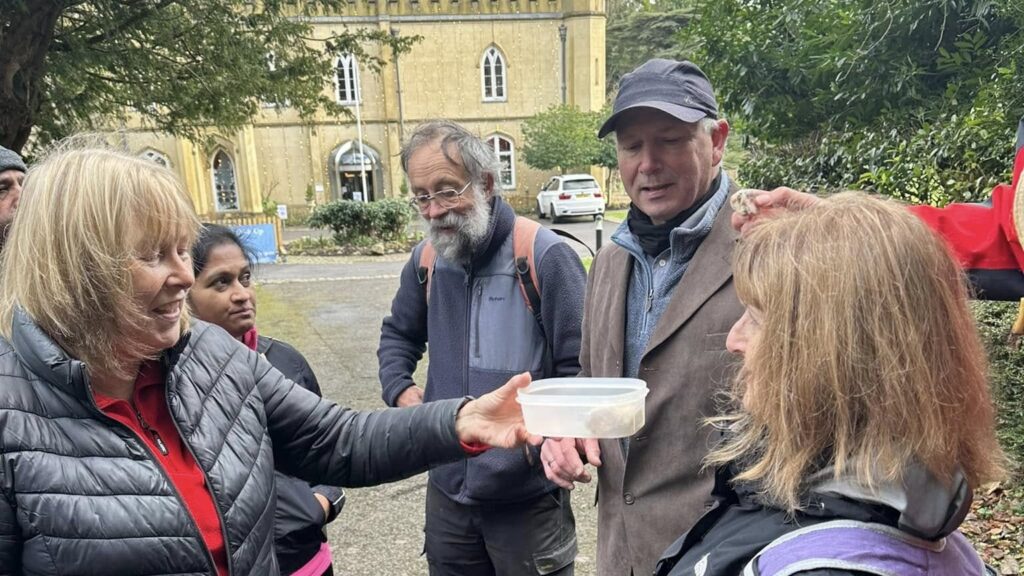
As they trod along the winding paths, they stumbled upon a door in the middle of a hedgerow painted a bright, enticing red. It beckoned them and beyond was an enchanted forest where trees whispered secrets and streams chuckled gently.
Suddenly, an Oompa Loompa security guard appeared out of nowhere and spoke in a velvet voice: “Only those who believe in the extraordinary shall pass.” They were led around the farm to a hidden glade and their hearts pounded with excitement as scones fell like rain and emerging from a chocolate river was Wonka Percy with his top hat and mischievous grin. He welcomed them warmly with hints of cream tea haunts. Beside him stood Matilda Moore her eyes twinkling with intelligence and curiosity and with a flick of her hair she revealed her telekinetic powers conjuring up Peterley and coffee for all. The ramblers knew their journey had just begun, filled with delights and marvels that only Great Missenden, with its Oompa-Loompas, Willy Wonka, and Matilda, could hold.
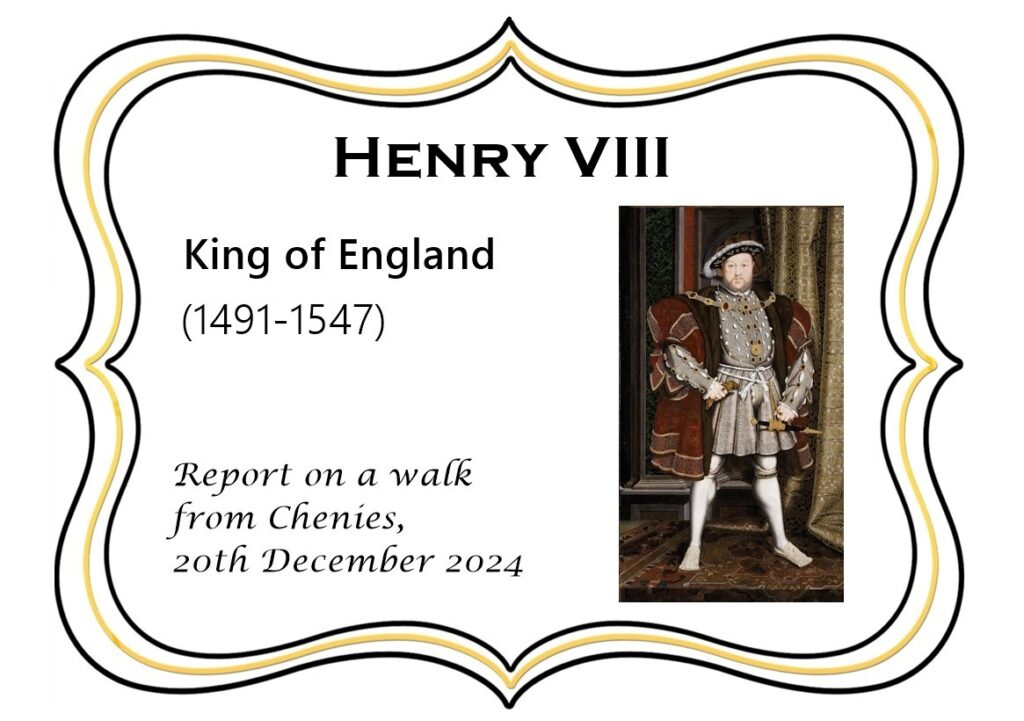
On a bright and sunny December morning nine eager ramblers set off from the quaint village of Chenies. This was no ordinary walk. It was their annual Christmas ramble. Each step brought them closer to a beautiful spot by the River Chess where they paused to share festive treats. A large thermos of mulled wine with the rich aroma of spices and warm red wine and freshly baked mince pies filled with a rich, fruity mix that melted in their mouths and stollen, generously dusted with powdered sugar.
Inspired, they decided to serenade the quiet countryside with a festive twist of the rendition of Henry VIII I am.
“I’m Henry the Eighth, I am, Henry the Eighth I am, I am!
I’ve been rambling with these nine,
With mulled wine and pies so fine.”
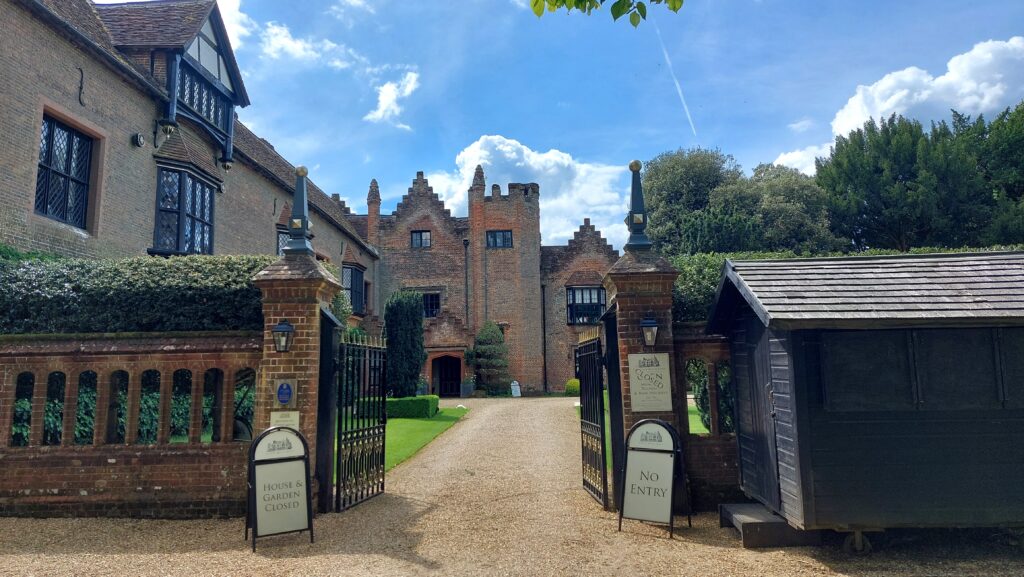
Admiring Chenies Manor, they felt a deep sense of gratitude for the simple pleasures of good company, festive treats, and the beautiful Chiltern countryside and promised to make their Christmas ramble an even grander tradition.
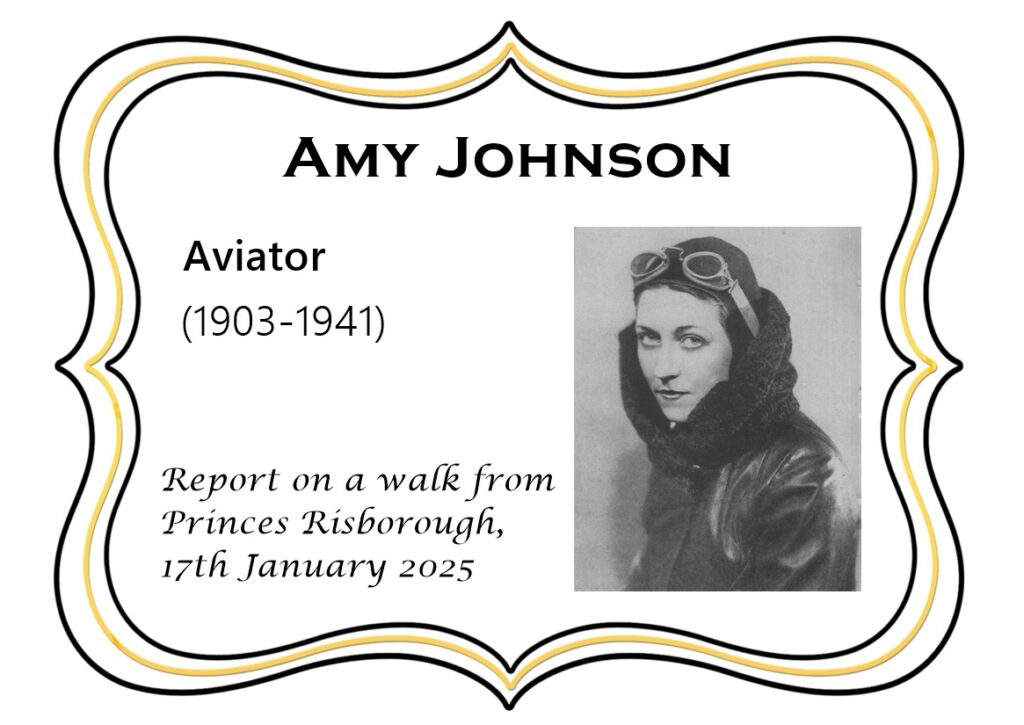
She was the first woman to fly solo from London to Australia, and lived in Princes Risborough and Wooburn Green.
On a clear morning, of the sort that urges even the most grounded of ramblers to take flight, a small group, with their spirits as free as a biplane’s glide, soared to new heights as they meandered through the charming streets of Princes Risborough.
Under the command of Captain Kearey safety protocols were meticulously planned and executed with unwavering precision. Paying attention to the announcements, the esteemed comrades laced their boots, adorned their silk scarves, donned their Biggles helmets and buckled their rucksacks for take-off as they anticipated the thrill of wading through muddy fields. Their kit bags were equipped with cutting-edge technology to ensure a smooth journey and the ‘Cooper, Nelly & Pippa’ pioneering spirit provided a compass through the uncharted areas of the Phoenix Trail.
As they embarked on this aerial adventure they turned their attention to the illustrious accomplishments of the legendary Amy Johnson, a paragon of aviation prowess. They found themselves magnetically drawn to a modest abode, the very house where her dreams of the impossible became reality.
In the golden age of flight, she flew solo to Darwin. This daring voyage marked her as the premier woman to conquer such a formidable route. Conversations sparked, filled with the unmistakable hum of admiration and awe, much like the drone of the Gypsy Moth. With each step, the legacy of Amy took flight anew, carried on the wings of those who dared to dream and wander. Happy landings.
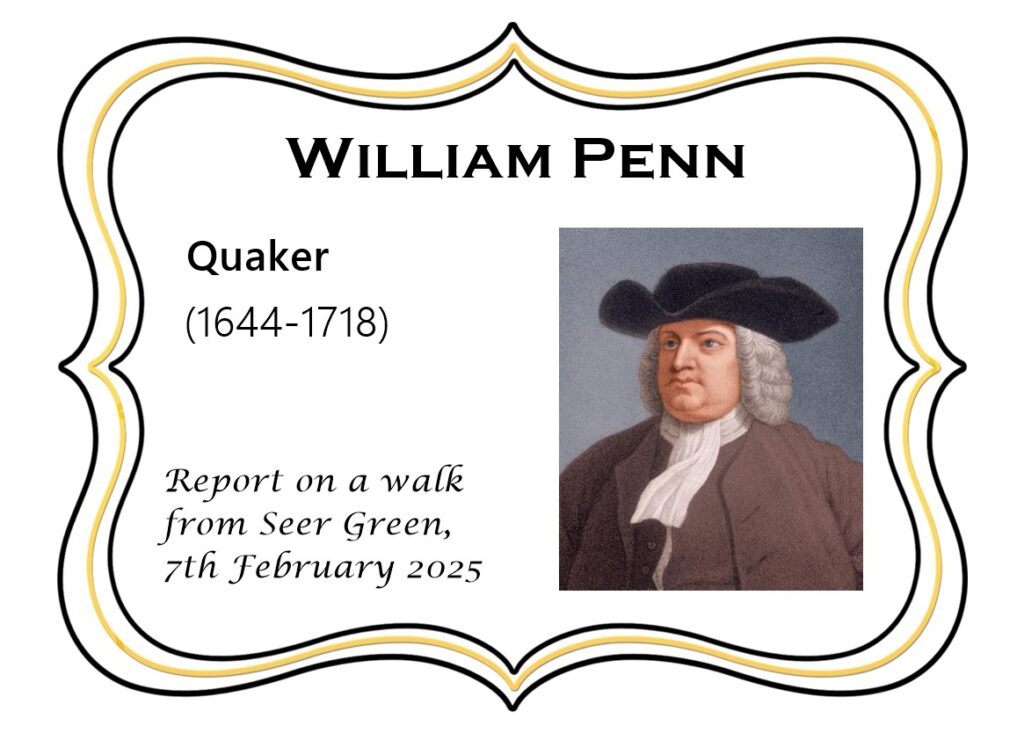
In the quaint and rustic village of Penn where the verdant hills embrace the cerulean sky, rambler kindred spirits found solace and tranquillity amidst nature’s opulence. In this pursuit, they were not merely wanderers of the land, but seekers of truth and wisdom, guided by the principles of integrity and humility.
The undulating pathways and tumultuous mud, like veins of the very earth, beckoned as they sought communion with the land, traversing the lush meadows and ancient woodlands.
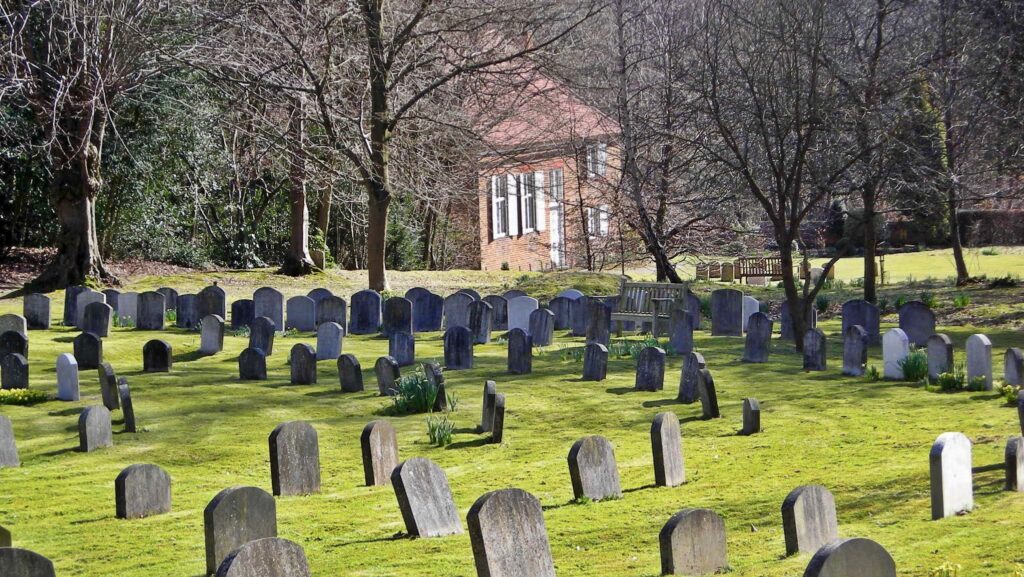
This pilgrimage of sorts, in pursuit of serenity and reflection, hearkened to the virtues of simplicity and the profound beauty of God’s creation. Their sojourn to the Quaker Meeting House was a testament to the enduring bond between man and nature, a harmonious dance that enriched the soul and elevates the spirit.
As the walkers embarked upon their journey, the sound of the bitterly cold wind and the sound of the hail on raincoats provided a celestial symphony, harmonising with the rhythmic footfalls of the travellers. Their spirits unburdened by worldly concerns, they took each step with reverence, mindful of the interwoven tapestry of life that unfurled before them.
Afterwards the Cricketers public house, with its idyllic charm, crackling log fires and pastoral grace, offered a sanctuary for introspection and contemplation.
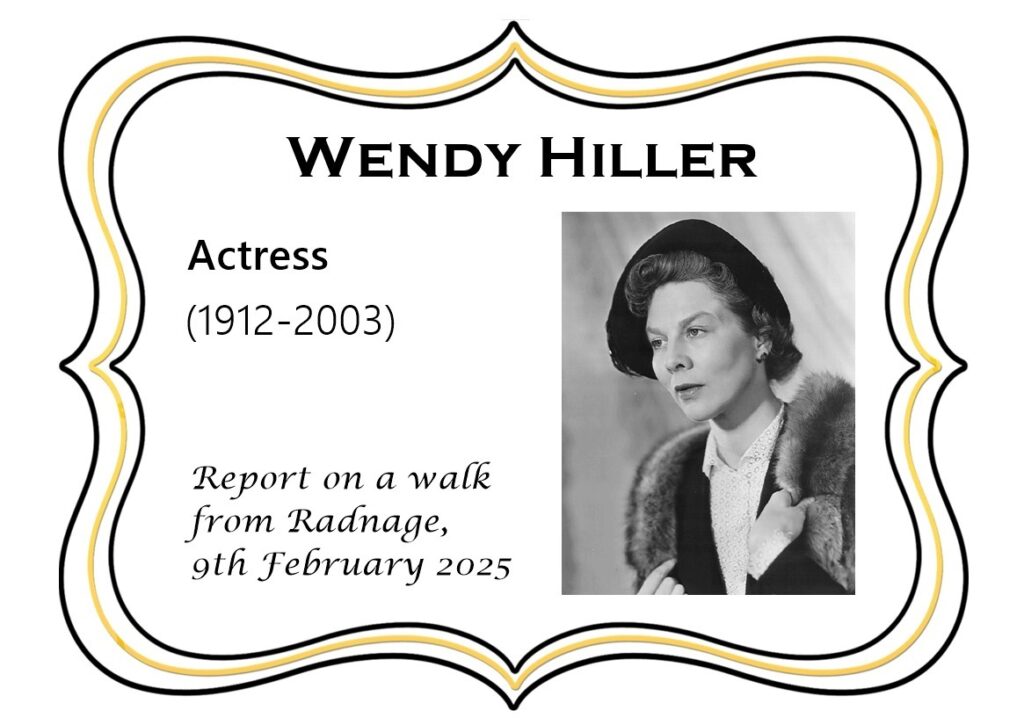
Dame Wendy spent much of her life in Beaconsfield and was president of the Chiltern Shakespeare Company.
In the style of George Bernard Shaw:
Ah, the idyllic English countryside where even the ramblers possess a flair for the dramatic! Envision, if you will, the merry band of walkers, swathed in moisture-wicking fabrics, on a pastoral amble towards the hallowed precincts of Radnage Church. Their quest? An embodiment of bucolic bliss and a quadrifocal of the sepulchre of Bernard Shaw’s favoured leading lady, the illustrious Wendy Hillier; a cream tea fit for deities, and music to soothe the weary soul.
Witty banter flows as freely as the winter breeze, for what is a ramble without a touch of verbal sparring? The mist both diffident and insistent, throws an almost theatrical cloak upon the verdant fields and meandering paths.
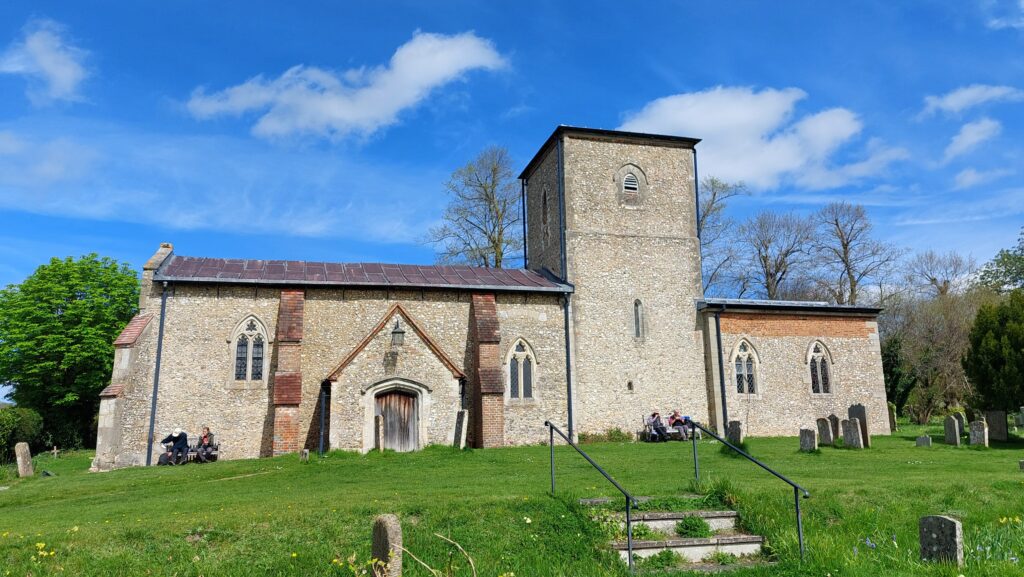
They arrive at the church, a gem of ecclesiastical architecture, standing as a sentinel of history and unearth the final resting place of the thespian legend, an actress of such resplendence that her grave has become a shrine for the culturally inclined. Even in death, she commands a devoted audience. In this tableau of rural charm, one discerns a symphony of life’s simple pleasures and the inexorable passage of time.
The scene then shifts to the vestry, where the scent of freshly-baked cakes wafts through the air, promising a repast that would satiate even the most discerning of palates. Ah, the sheer ecstasy of it – a pastoral symphony, where history, gastronomy, and melody entwine in a harmonious embrace.
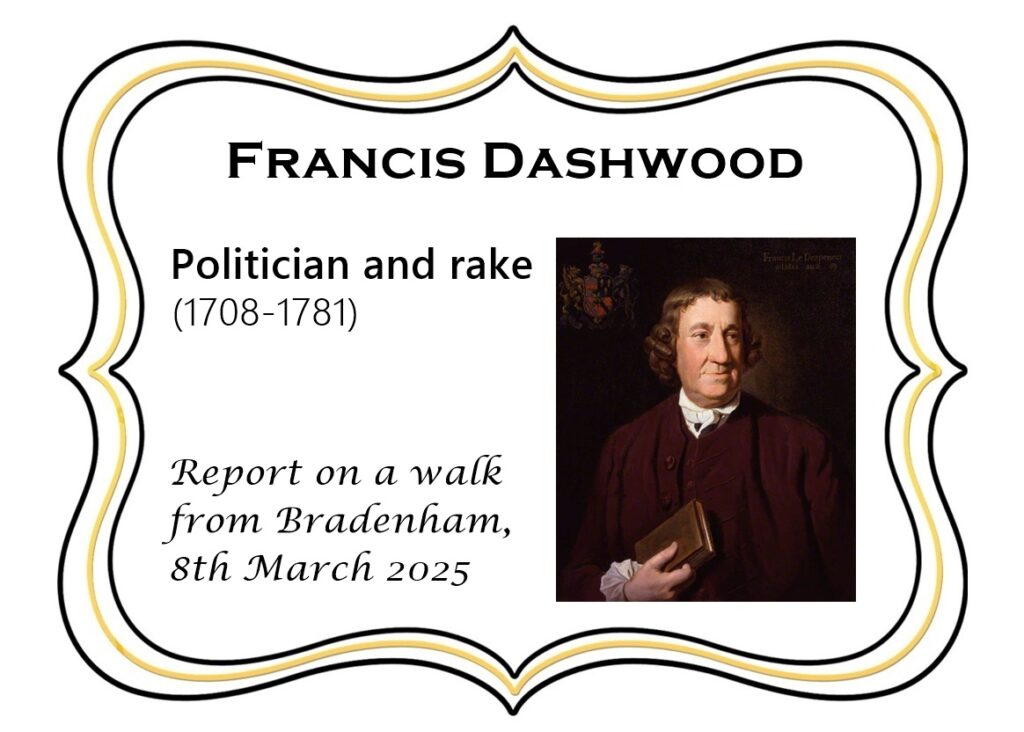
In the year of our Lord, an ebullient company of twenty-four stout-hearted Ramblers, accompanied by five four-legged companions of varying disposition, did assemble to perambulate West Wycombe.
Their jaunt proceeded merrily without canine quarrel and the journey wove together the sublime charms of the Dashwood Mausoleum, the Hell Fire Caves, the venerable St Lawrence Church, the enchanting Walled Gardens, and concluded with a convivial retreat to the renowned Red Lion Tea Rooms.
At the site of the Hellfire Caves the company could scarcely contain their mixture of trepidation and thrill. As the party loitered by the dark entrails, Mr Kearey encountered what he swore to be a spectral glow though it proved to be merely his own shadow. The church, perched atop a hill, greeted them with a breathtaking vista of the surrounding countryside and the tranquil charm of its historic architecture.
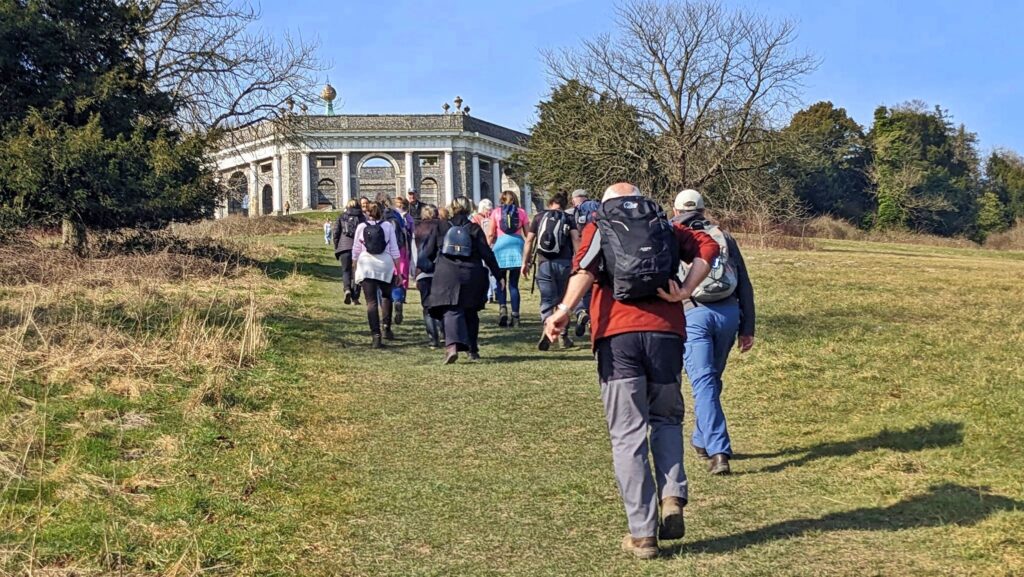
The group were captivated by the Dashwood Mausoleum, majestic Georgian edifice of Portland stone and flint, standing sentinel over the Chiltern Hills with panoramic views of the storied legacy of the Dashwood family. To conclude their revelries the group repaired to the Red Lion Tea Rooms, a quintessentially British haven. This harmonious blend of history, nature, and warm hospitality made for a most memorable spring outing.

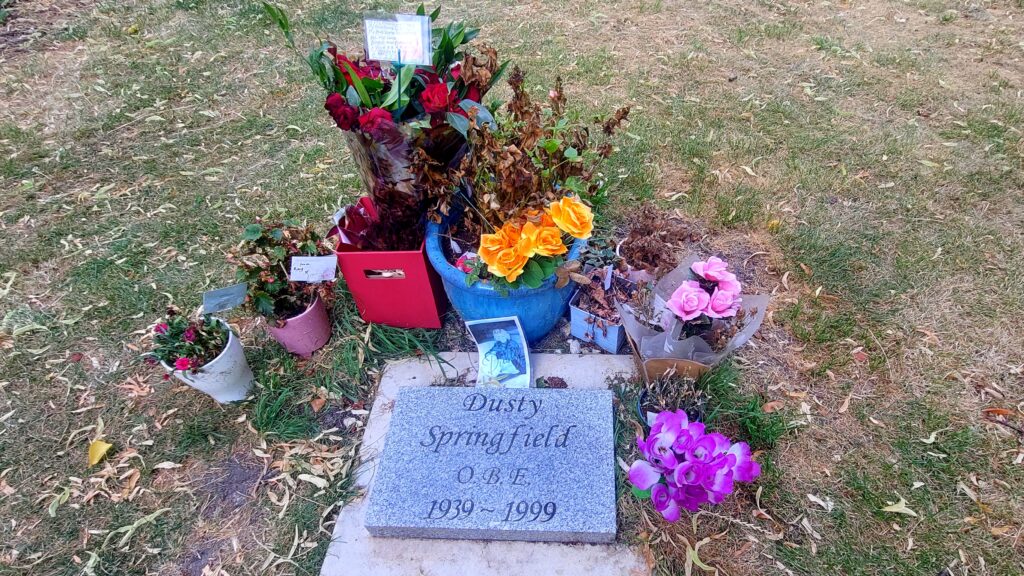
An icon of the Swinging Sixties, Dusty Springfield had a string of hits including Son of a Preacher Man.
Simon K was a preacher’s son
As walkers gathered he’d come along
By Little Angel they started talkin’
That’s when Simon would take them walkin’
Over fields they’d go walkin’
The rhythm of the river played a tune so sweet.
The only one who could ever lead us
Was the son of a preacher man
The only man who could ever teach us
Was the son of a preacher man
Yes he was, he was
Ooh, yes he was
Yes he was (was), he was (was)
(Ooh) ooh, yes he was.
Walking hills isn’t always easy
No matter how hard they try (ooh-ooh)
With every step hearts a beating
Ramblers in Henley when the sun shone on.
Laughter in their pockets, and freedom on their minds.
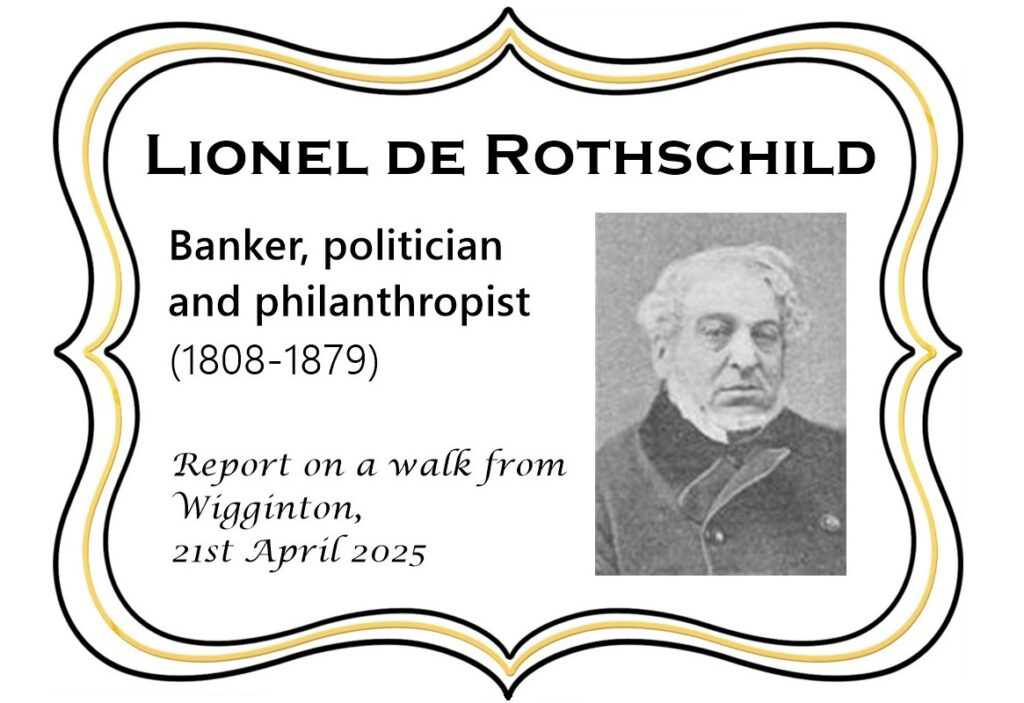
He bought the Tring Park Estate in 1872.
Upon a grey morn in the season of spring, 11 intrepid ramblers of the CWW set forth upon the verdant paths of Tring Park hoping to see the legendary critter sitter and naked horticulturist in a hammock pruning exotic blooms. Amongst their company was a most peculiar sight, a photogenic Polish chicken perched regally in a pushchair. Cameras clicked and laughter echoed through the park as the ramblers paused to capture the quirky moment.
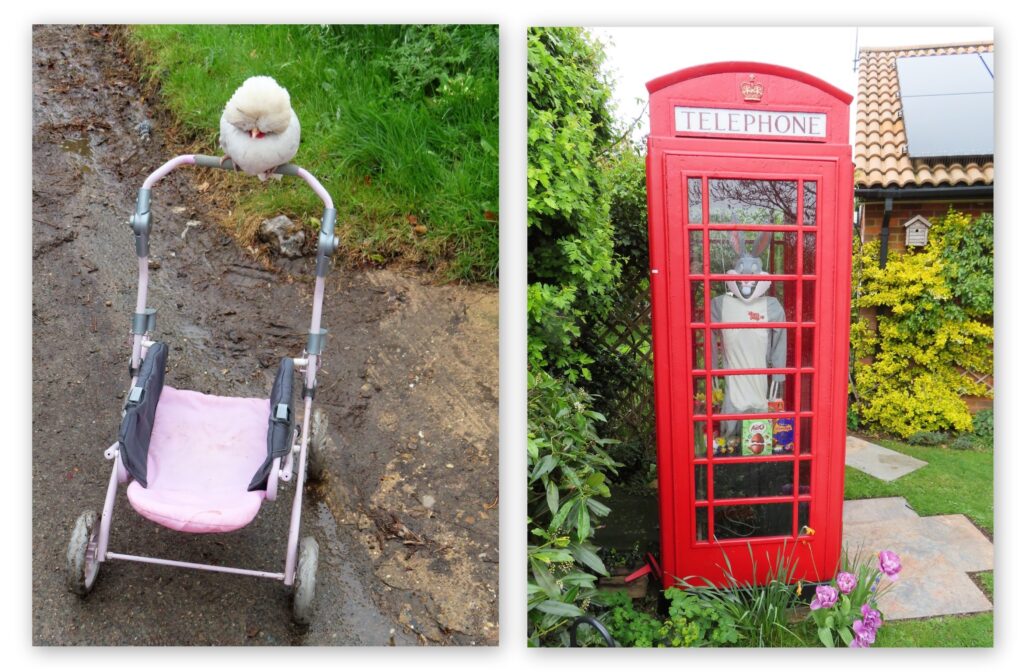
As they traversed the pastoral realm, the ramblers espied a curious spectacle: an Easter Bugs Bunny confined in an antiquated telephonic apparatus, a playful nod to the season and eliciting much gaiety and astonishment amongst the company.
Continuing in their enterprise, the party was guided to the Hedgehog Run, a thoroughfare dedicated to the preservation and celebration of those spiny beasts. There was discourse upon matters of nature and the stewardship of the earth, and hearts were warmed by the park’s harmonious union of man and creature. The day ended with a snack at the Wigginton Café leaving the group with cherished memories of their adventure.
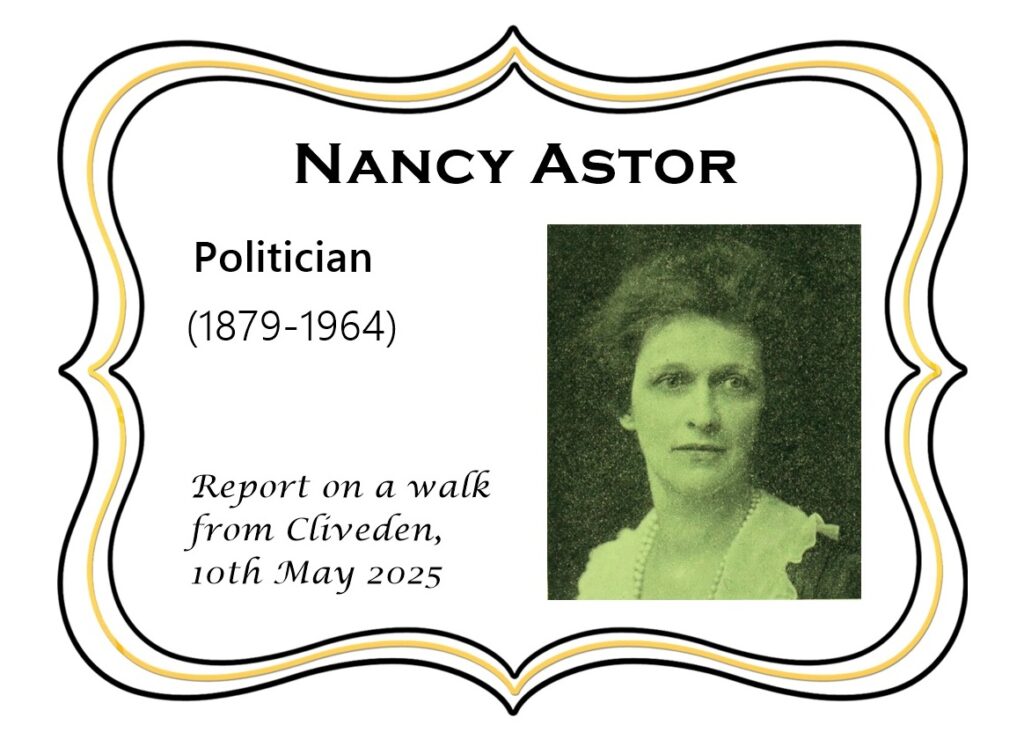
It was a day so fine it looked as if England had snatched a touch of Riviera charm. Cliveden’s gilded halls of nature, stately gardens and grand estate were graced with the sun’s golden glow and the Thames, a quiet confidante to the day’s affairs, glistened with good humour. The merry CWW band of seven, with number eight joining them later, having ascended all the steps on the estate in search of her comrades, wove through the historic grounds. They appreciated the majesty of both land and river.
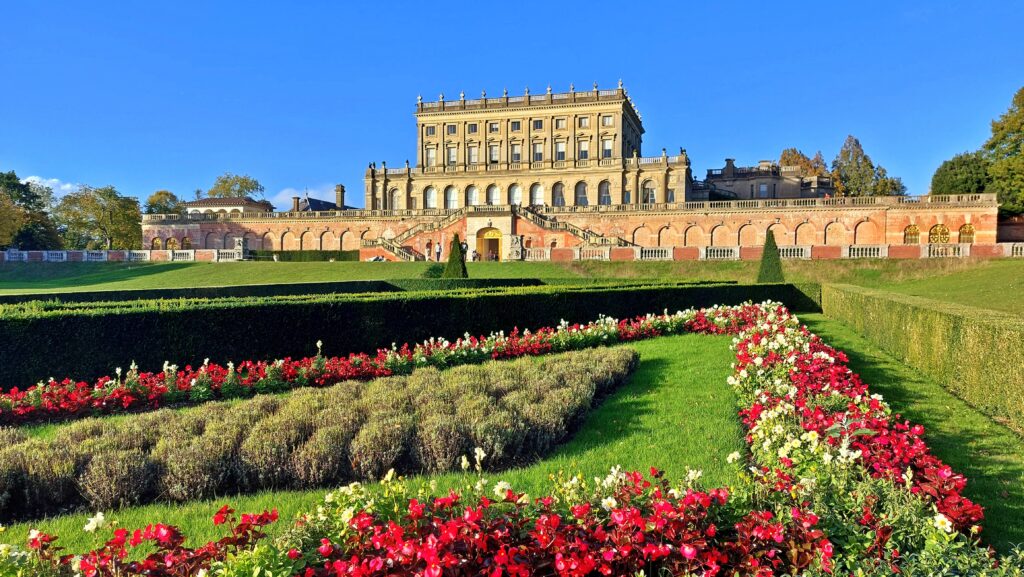
In due course refreshments were taken, for even the most industrious of wanderers must acknowledge the necessity of sustenance. With tales of diplomacy and delight the conversation was lively and varied from politics to poetry, history to gossip. The energy of this discourse resembled that which once animated the halls of Westminster – though doubtless it was more agreeable in tone. If all deliberations took place in such fair surroundings, one dares to think how much more agreeable the affairs of the nation might be.
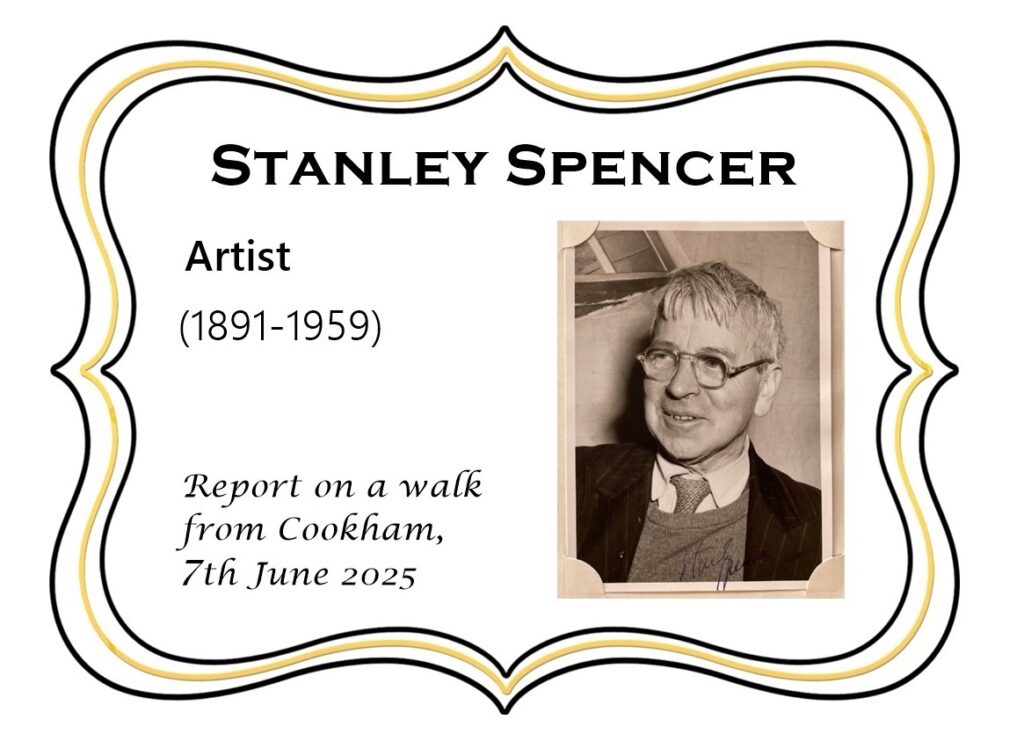
The celebrated painter spent much of his life in Cookham, which he described as “a village in heaven”.
Five congregated at Bourne End, whilst another two, deterred by meteorological conditions, sagely lingered at home. In spite of a yellow weather warning, initially these hardy souls were kissed by a burst of golden light, and this increased their smugness. Little knowing that on this June evening their journey would be storm-laced and they would be at the mercy of the shifting sky, one moment bathed in piercing shafts of sunshine and the next lashed by sheets of torrential rain.
As predicted, a mile in, the sun scurried behind a black cloud and was replaced by a torrent of rain. It felt as if Cookham itself was testing their resolve. Notwithstanding this, shoulders hunched against the elements, they endured and ploughed forward, boots sucking at the sodden earth. The Thames path became a tapestry, woven with puddles shimmering like molten silver gleaming under the grey sky’s watchful gaze.
Bound by a reverence for art and the land they defied the bleakness. Surveying the Thames, by now swollen but serene, they glimpsed a bevy of swans protecting a whiteness of cygnets and, on the opposite bank, a passing giraffe. Soon Spencer’s ‘village in heaven’, where brush strokes stitch the sacred into the everyday and the mundane is intertwined with the spiritual, was revealed.
Homeward bound, having imbued this feast of artistry, the rain came again. Taking refuge in the Bounty, now steaming gently, the mud clinging to their boots and their cheeks still flushed from their battle with the storm, they realised that, as well as being walkers, they had borne witness to a moving immortalised landscape and were connected, not just to the land, but to its memory.
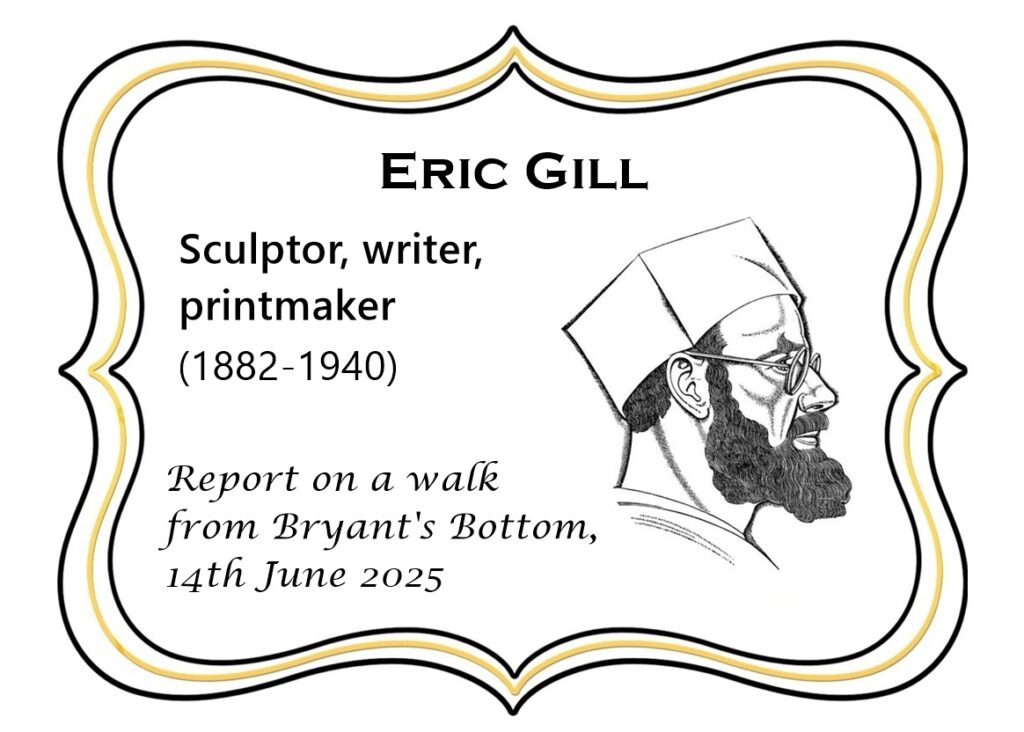
The “greatest artist-craftsman of the 20th century” lived at Pigotts near Upper North Dean and is buried at Speen Baptist Church.
One sunny afternoon in June a dozen CWW ramblers met at the Gate to trundle the rolling Chiltern Hills. Onwards and upwards, their destination was Pigotts Music Camp in North Dean, a place of sound and craft. The countryside shimmered under the summer sun; the fields were embroidered with wildflowers and the birds chirped from within the dense hedgerows.
Amid the group, was a peculiar sight, a vehicle, a pram, rumbling over the uneven tracks, its occupants not babies but two small, eager dogs peering out like royalty, commanding all that they surveyed as well as their master.

Hoping to stumble upon Eric Gill, the eccentric, controversial renowned sculptor and typographer, they arrived to find the camp empty. The strains of strings and voices that had once mingled with the aroma of wood, freshly cut were now silent. Gill, ever the eccentric and intriguing, was absent and so was the welcome and engaging discourse about the significance of type casts fluid, shaped and meaningful.
Had they encountered him they would also have felt something darker, something known, spoken but yet unspoken, like a last word engraved, sharp and necessary.
Carrying the weight of unchallenged conviction, they returned to the Gate and, as they sat in the sunshine, the two canines, now freed from their absurd carriage, curled up on the lap of their owner as the walkers told stories that hung in the air like the scent of old ale and history.
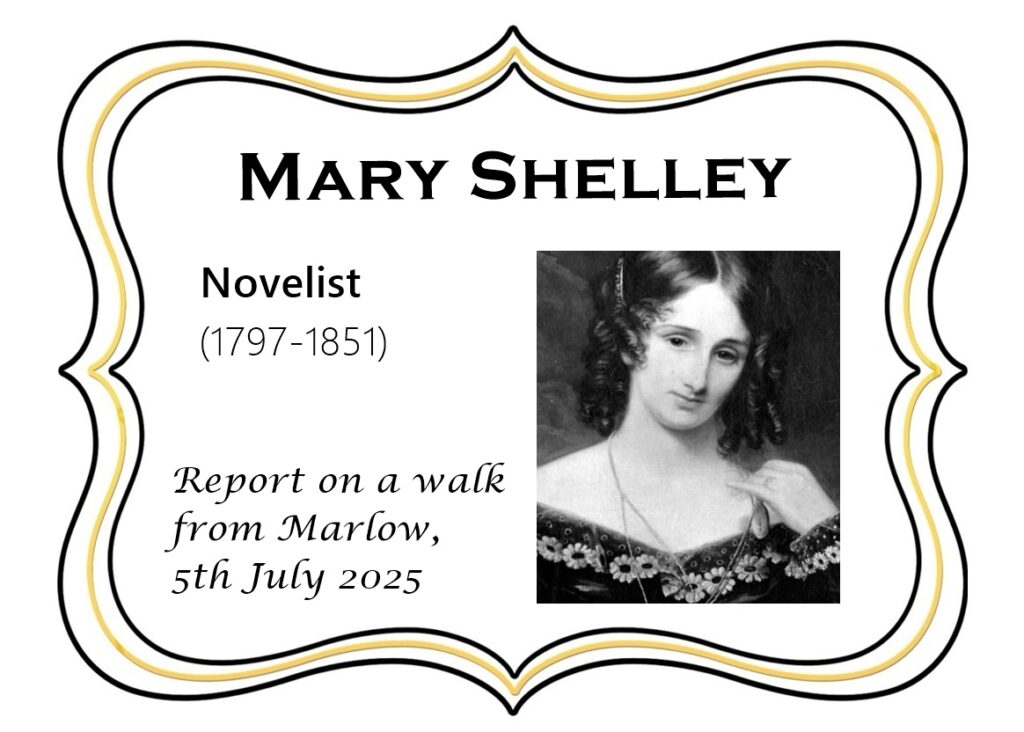
The writer completed Frankenstein while living in Marlow.
As the sun’s glow waned, casting long shadows the six souls, ramblers of the CWW, stepped into Marlow’s twilight hush. They were hunting the ghost of Mary Shelley’s imagination. They paused at the hollow as the creature, a vision, created with quill and ink that embalmed life into the pages, rose from the phoenix. It was Frankenstein, a clone of life itself. Their laughter, masking fear, crackled like lightning, as they dashed to the safety of Temple Lock to take solace in the flapjacks rich with oats, dates and kindness. Hence man, monster, and memory met at Marlow not in horror, but in harmony.
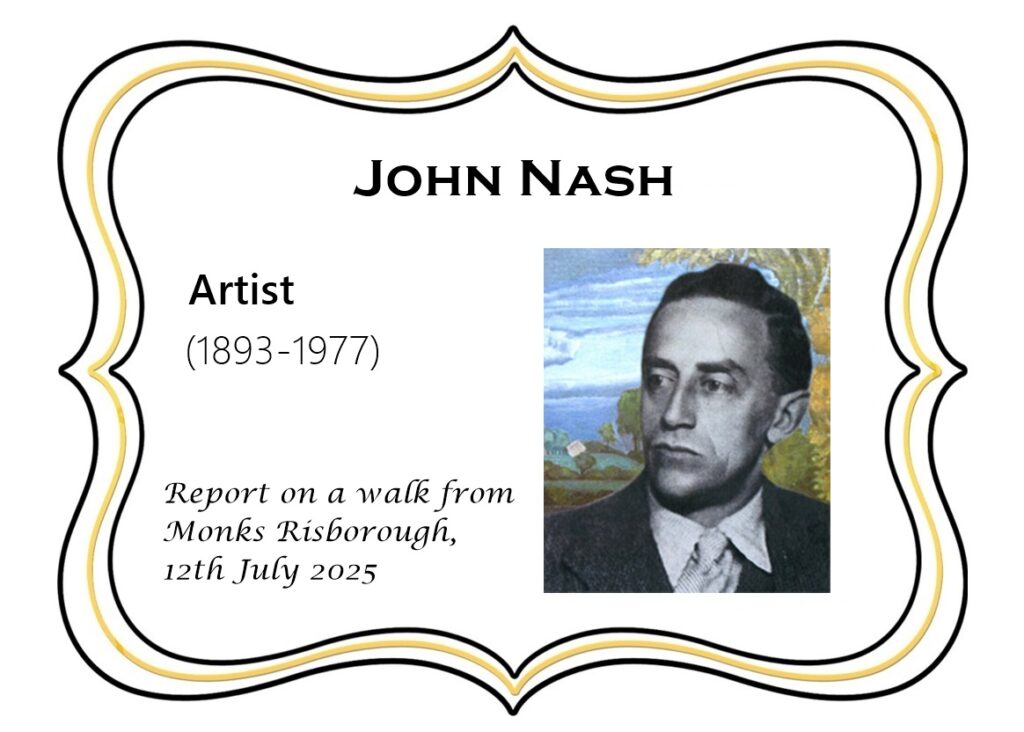
The painter, illustrator and engraver lived in Gerrards Cross and Princes Risborough..
As they congregated at Monks Risborough where St. Dunstan’s Church offered blessed shade even Michael Mosley, with just one thing, might have smiled on them, whilst preaching hydration and brisk walking to boost longevity. None were willing to heed the Noel Coward lament ‘Only mad dogs and five Englishmen and one woman go out in the midday sun’, as despite this cautionary tale resonating in their ears, they set off with sun kissed zeal undeterred in their quest to seek John Nash.
As the sun burnt the canvas, the chirps of birds were quietened by the searing heat and hues were too wild to tame. Suddenly the vista of Aylesbury Vale arose like a phoenix from the ashes of Buckinghamshire. But was this enough to awaken and inspire John Nash to wield his brush with pastoral calm, capturing the butterflies blue, the herd of deer harbouring from the searing heat beneath the boughs of the spreading chestnut trees?
There, bobbing bizarrely above the mirth, the leader with Benny Hill hat, symbolic of mischief in motion, crowned the moment with merry madness.
Reflecting indoors in shaded gloom,
within the comfort of my room,
what if I’d laced boots with the boldest
Although I might have been the oldest
Mad dogs, midday folk …and me
Very sweating I would be
Should I have faced the solar flare?
I don’t know – I wasn’t there
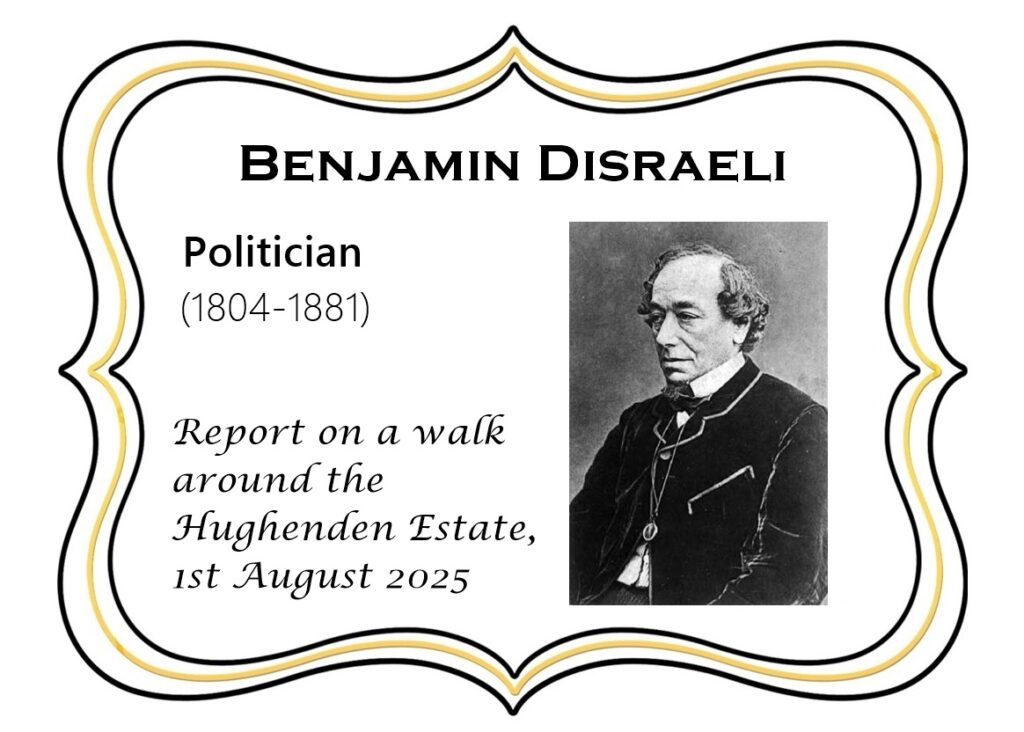
Britain’s first and so far only Jewish Prime Minister lived at Hughenden from 1848 until his death in 1881. He and his wife are buried at St Michael and All Angels Church.
Once upon a time 20 gallant CWW walkers and one highly trained hearing dog, vying to become walk leader set off on a ramble across the Hughenden estate. United by their quest for adventure, exercise, friendship and knowledge they had come ready to learn about Benjamin Disraeli. He was Queen Victoria’s bestie and affectionately known as ‘Dizzy’ not because of his Victorian statesmanship but because of his flair for drama and cravats that could double as table runners.
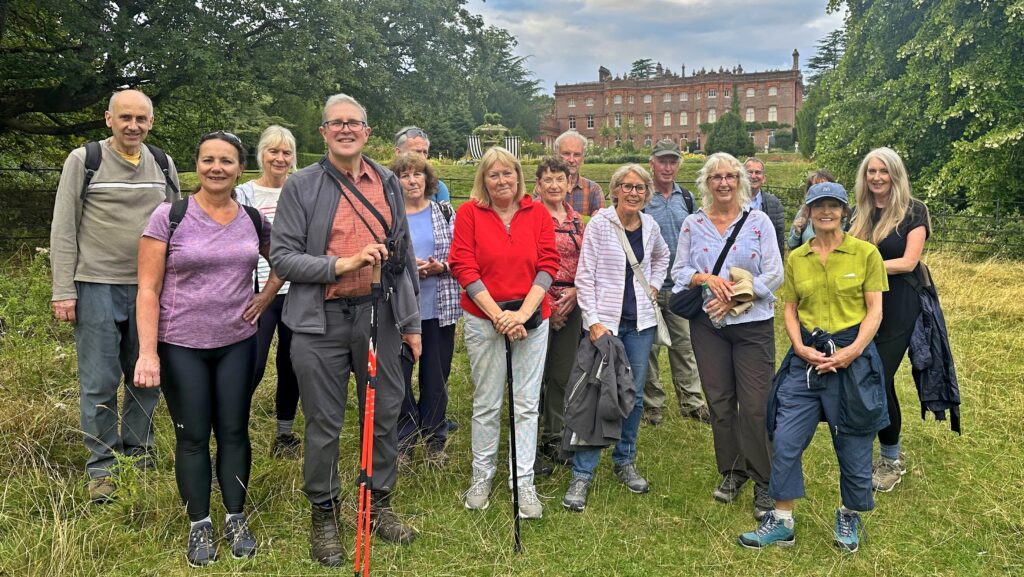
Sulking because he had been thwarted as walk leader, Nelson put himself in charge of health and safety and quality control, sniffing each hedge, bench, and unsuspecting ankle for historical accuracy and alerting the walkers to accumulations of dog poo.
Then there was the annual barbecue, with King Michael on the throne assisted by Queen Anne, presiding over the sacred rite of blessing the charred Quorn burgers and orchestrating the sausage flare-ups and managing the bangers with attitude. There were enough strawberries to sink a moderately sized bird bath and the all-important quiz on ‘Fallout Modelling for CWW BBQ Safety’. Here the crowd were tested on the correct protocol to follow if one becomes entangled in a rocket salad; the safest evacuation route in the event of a strawberry cheesecake landslide; and whether if the host refuses to serve food until everyone has admired their latest car boot collection, it becomes a reportable safeguarding issue.
When some mistook a garden ornament for the ghost of Disraeli, the walkers knew they had had made history, or at least hilarious memories and, if Benjamin was looking down on this revelry, he would surely be asking “What in heaven’s name is a Quorn burger?”
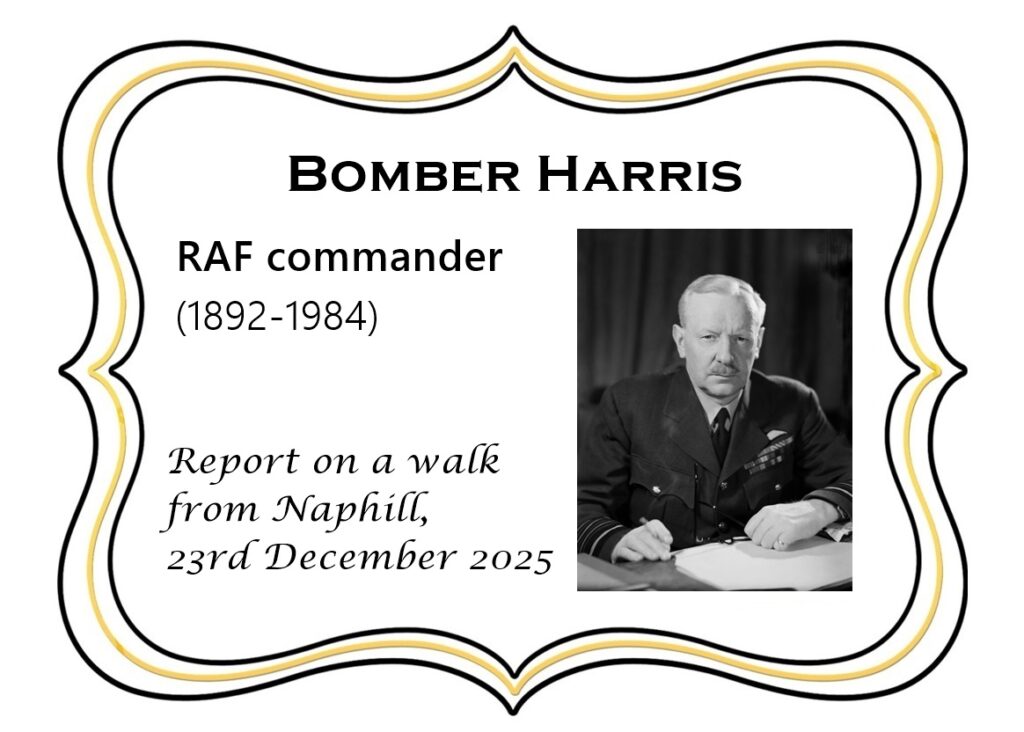
Marshal of the Royal Air Force Sir Arthur Harris directed deadly wartime raids on Germany from Bomber Command in Walter’s Ash.
Setting off at 11:00 under commander Kearey, 15 ramblers in full combat gear prepared to tackle the rolling ground around Naphill. The complaints about ‘these damned inclines’ were not upheld. As a column they advanced steadily through the beechwood forest, dodging the mud and ever vigilant to the threat of the enemy, pausing to photograph ascocoryne sarcoides (also known as jelly drops, purple jellydisc or gasoline fungus). Morale remained high and rations were ample. Mince pies and hip flasks of mulled wine were consumed with glee. As in any operation, discipline was essential. No one rushed, no one lagged. The objective was simple: cover the ground, avoid the unexploded ordnance, enjoy the day and get home in one piece.
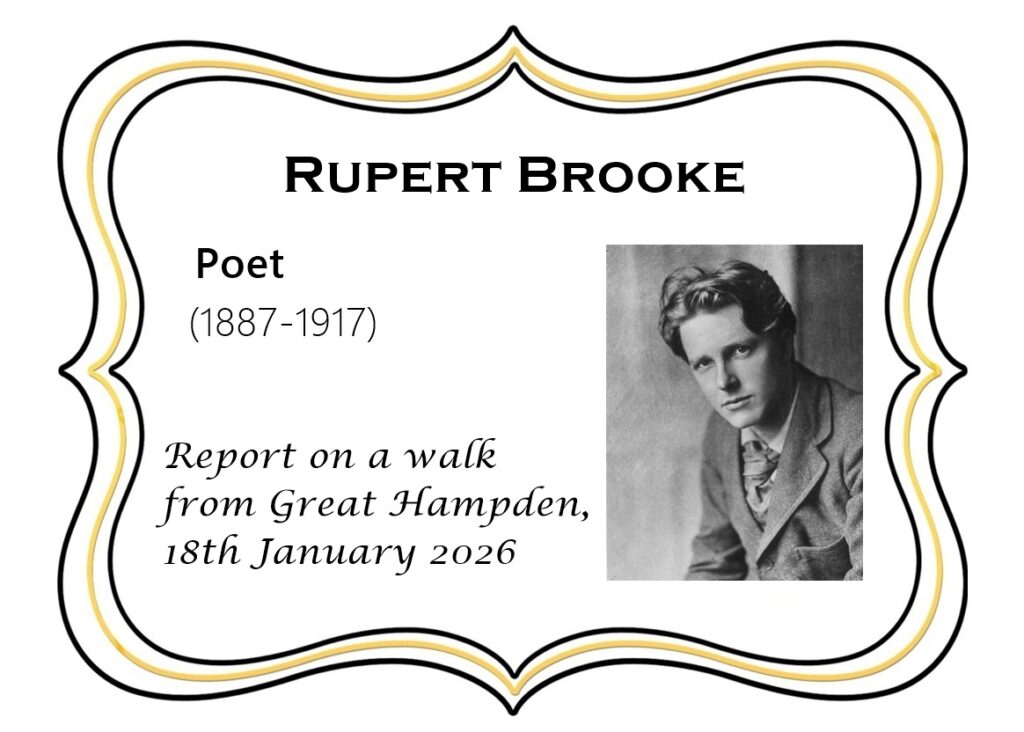
The First World War poet loved walking in the Chilterns and visiting the Pink & Lily pub in Lacey Green.
On a grey Sunday 17 CWW members gathered for a literary pilgrimage to walk in the footsteps of Rupert Brooke, the author of ‘The Soldier’. Determined to find the very spots where the poet might have paused, sighed or adjusted his socks, they set off in a merry file.
Not deterred by the mist and damp, their boots trudged upon the loam. Even on this grey day, the beechwoods seemed to glow and fields seemed to breathe in long slow rhythms amid the softly contoured hills. Their leader quoted lines from Brooke: ‘If I should die, think only this of me.’ Some correctly, some with great confidence but absolutely no accuracy.
They imagined Brooke ensconced by the fire at the Pink & Lily, contentedly composing his early poems. Meanwhile the Chilterns kept their secret beauty; urging discovery one thoughtful footstep at a time but where England was thought of as ‘a richer dust concealed’. They came, they walked, they recited Brooke and they didn’t lose anyone. A perfect day.
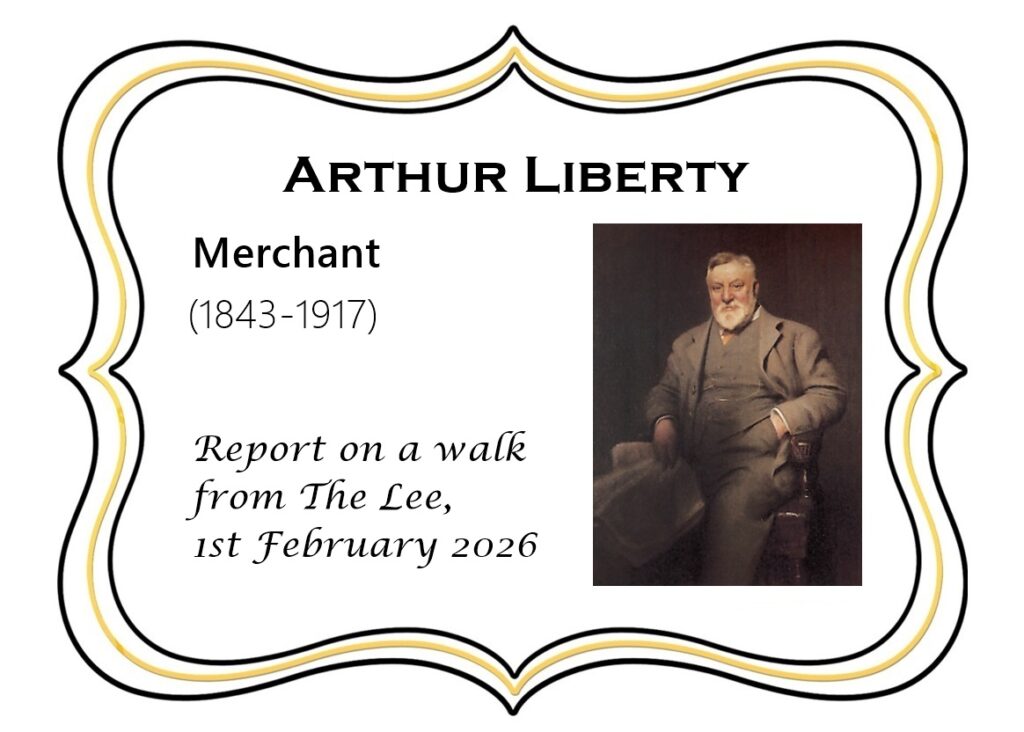
The Chesham-born founder of Liberty & Co in Regent Street lived in The Lee for over 30 years.
Eleven CWW ramblers welcomed five newcomers ready to follow in the footsteps of Arthur Lasenby Liberty, the visionary whose taste shaped both a Chiltern village and one of London’s most iconic shops. This was a unique ramble that aimed to link a landlocked ship’s figurehead with a Tudor‑style department store on Regent Street – nothing if not ambitious.
From Ballinger Common, where Liberty once kept his country retreat, the walkers took a gentle climb through woodland, navigating gingerly through the mud which wrapped itself around their boots in thick, cold layers, glossy like melted chocolate.
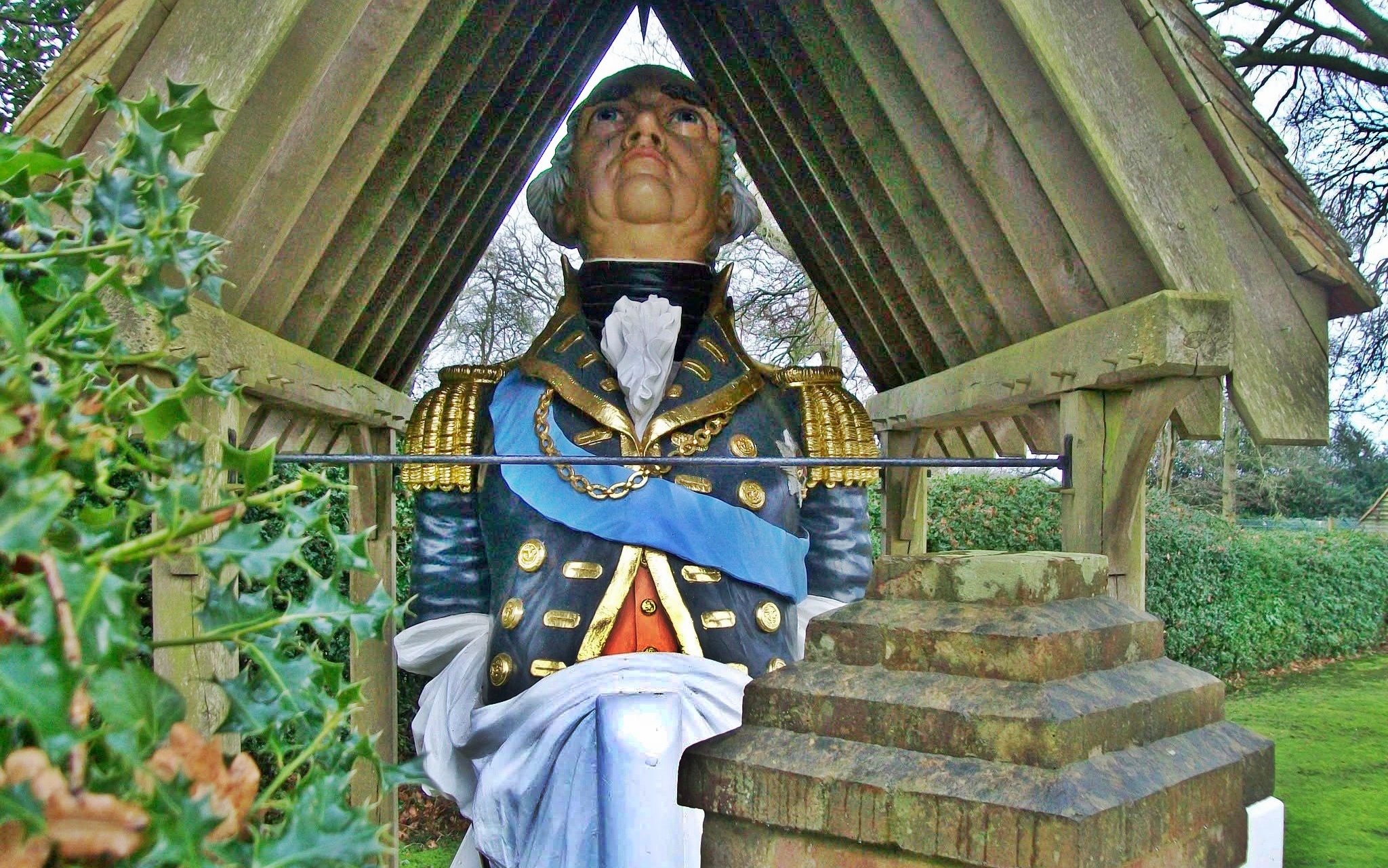
They wound on to The Lee, pausing to admire a carved figurehead – proud, weathered, wonderfully incongruous and unexpected. A maritime flourish marooned in the Chilterns, as if a galleon had taken a wrong turn somewhere near Great Missenden. As they stood in admiration they wondered if he had found it at a car boot sale and why a man who built a retail empire also decided he needed a nautical mascot in the Chilterns. The revelation that it mirrored the Liberty’s Regent Street shop, with its riot of colour from Liberty fabrics, and was built from the timbers of two ships made it less eccentric and more like a missing chapter of the same story.
Naturally, all roads (or at least all well-planned rambles) lead eventually to refreshment and confessions. The Cock & Rabbit beckoned, offering warmth and beverages and several walkers admitted to owning Liberty print scarves, shirts, or neck ties. Another CWW adventure successfully logged: part exercise, part history, part ramble, part fashion appreciation, and entirely in the spirit of Liberty.
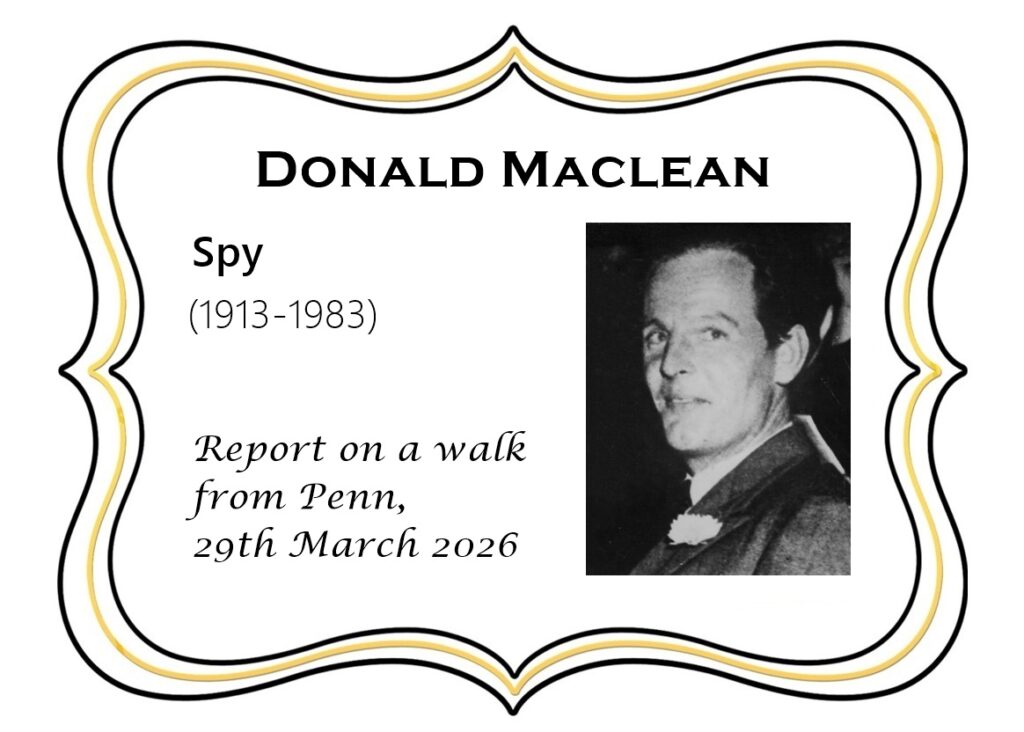
The diplomat turned Soviet spy is buried at Holy Trinity Church in Penn.
Thirteen CWW members walked through Penn Wood passing the same thickets that once concealed the fugitive steps of the spy Donald Maclean. Once a rising star in the Foreign Office, a brilliant diplomat and a devoted family man, he became one of the infamous Cambridge Five, a committed Soviet spy, secretly funnelling British secrets to Moscow.
These ramblers could almost sense the tension and the secrets absorbed by the landscape and his escape route which threaded straight through the Chilterns. Combining espionage with contradiction, he morphed from an educated, privileged man into a hunted traitor, often staying nearby with friends who offered him refuge and anonymity, as MI5 tightened its net. By the time he was exposed in 1951, he was drinking heavily – paranoid, and desperate. The weathered Celtic cross in the churchyard gives not a hint of the turmoil that once surrounded his name, just a peaceful corner of Penn holding its secrets.
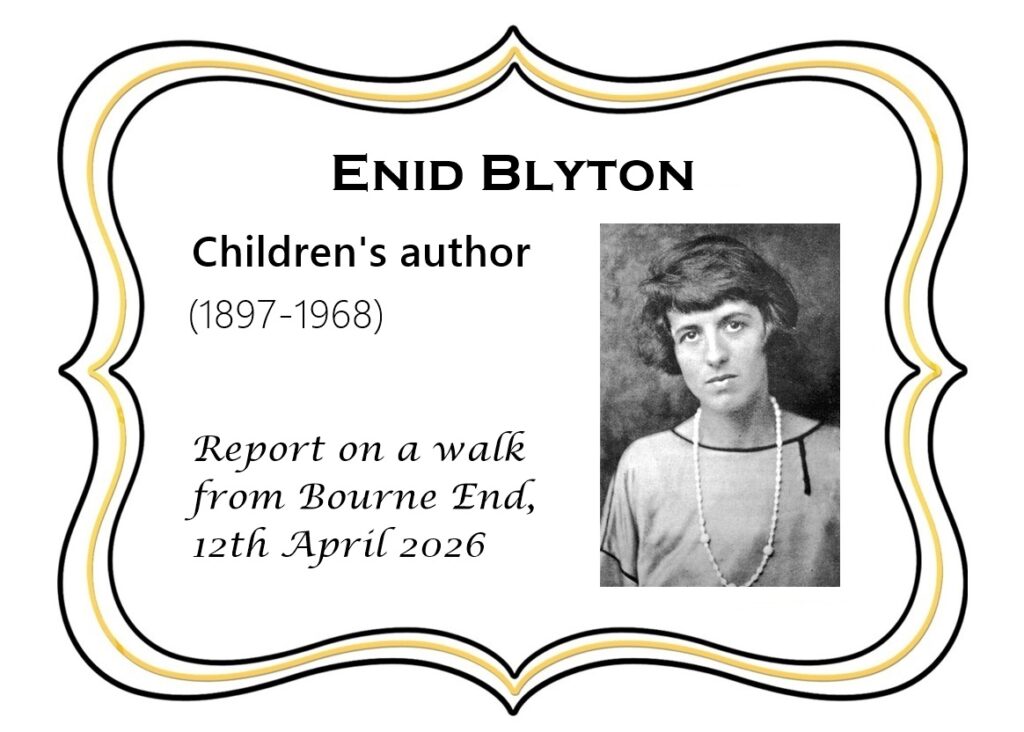
The prolific author lived in Bourne End from 1929-38 and Beaconsfield from 1938-68.
With the river sparkling, 20 set off from Bourne End with the same bright anticipation the Famous Five always had on the very best sort of day. “It’s a simply topping day for a walk,” said someone. As they followed the towpath towards Cookham, the countryside opened up in wide, friendly meadows that seemed to invite exploration.
They imagined Timmy bounding ahead, barking at boats and sniffing out secret paths. The group strode on in cheerful chatter, boots clomping, beady eyes sharp for anything remotely mysterious. A red kite wheeled overhead, a grebe navigating the river, sailing boats scudding hither and thither like the characters in a thrilling story.
As they reached Cookham they felt they had truly stepped into Enid Blyton’s world with a bright little car parked in the high street looking just like Noddy’s and the expectation of spotting Big Ears waving from a doorway. They strode on full of camaraderie and curiosity and eventually spied the Bounty riverside pub where they were rewarded with lashings of ginger beer.
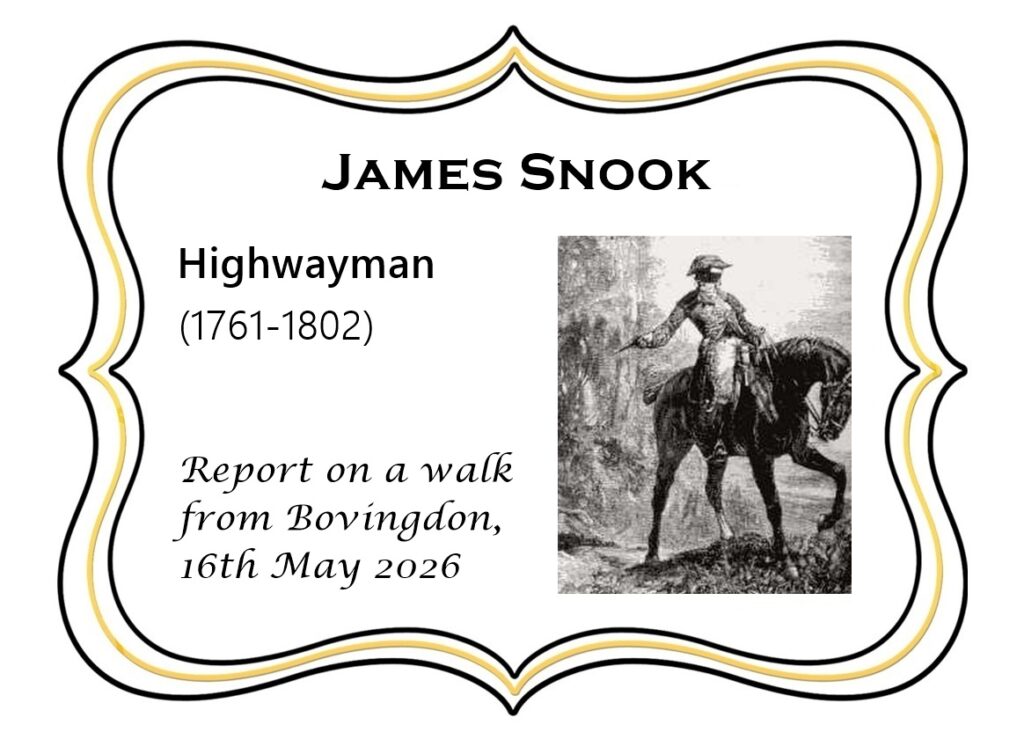
Snook, also known as Robert Snooks, was the last man to be hanged for highway robbery.
Our 14 walkers ventured onto Boxmoor nervously clutching their valuables. This was wild terrain stalked by highwaymen – none more feared than James Snook. For it was this arch villain who robbed a post boy of £80 in bank notes. Already a wanted man, Snook carelessly left a string of clues in his wake. He was swiftly apprehended and sent to the gallows.
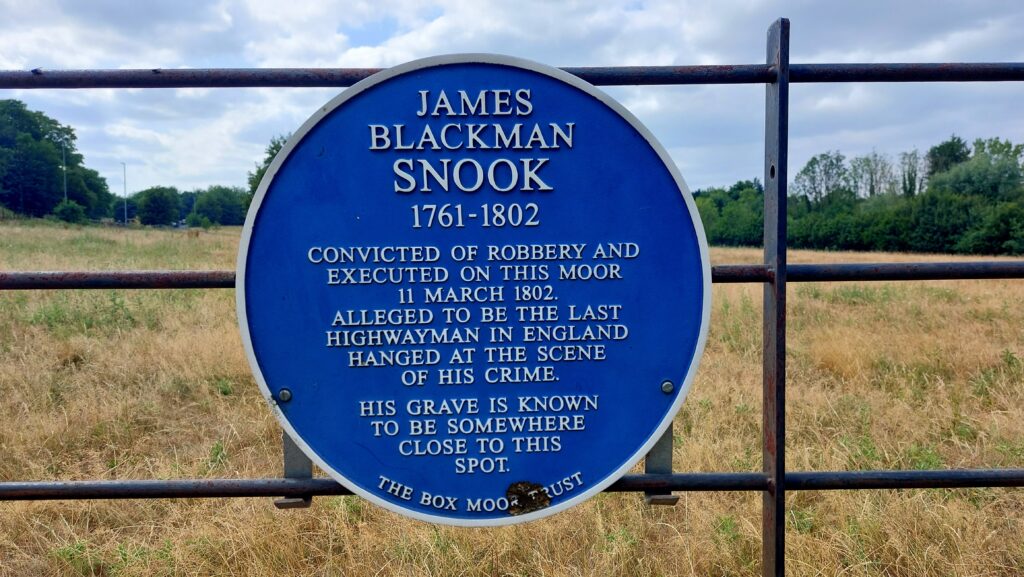
Reassured that justice had taken its course, our party pressed on past his memorial. But as evening cast its shadows, some nursed a nagging fear that Snook’s ghost might still be haunting the Moor…

The writer and humourist was best known for the comic travelogue Three Men in a Boat, written in 1889.
Jerome notes that a walking party of more than five is doomed to mild chaos. So when this group of six walkers assembled in Ewelme, each armed with a map, a water bottle and an entirely different opinion about the correct direction, the outcome was inevitable. Eventually, by democratic vote, they set off towards the church at Swyncombe.
As Jerome observed, a walking party divides naturally into subgroups. The Enthusiasts, striding ahead with a purposeful air, believing they are conquering the Alps rather than strolling through Oxfordshire; followed by the Naturalists stopping every few yards to take a photo. And bringing up the rear, the Philosophers, who maintain that walking is best enjoyed with frequent rests and cream teas. These walkers were finally united by the sight of a pub and a well-earned pint.
● Read more about the famous people in Simon’s presentation.
● Photo credits: Historic images from Wikimedia Commons. Stanley Spencer photo by kind permission of the Stanley Spencer Gallery. Additional photos by Tim Axten, Alan Cooper, Anne Kimber, Mark Percy, Anne Moore and Jal Tippell.